
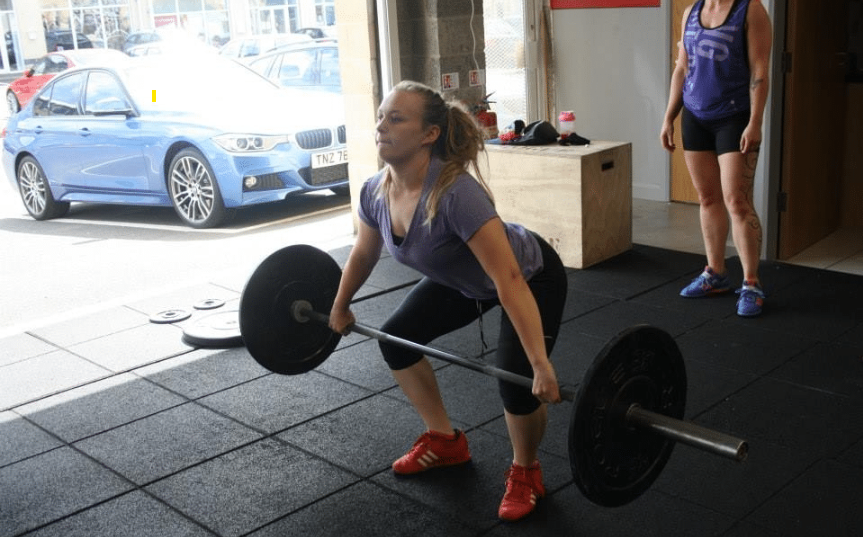
The Weightlifting Exercises:
Click the exercises to see some world class examples:
The Snatch: One (1) uninterrupted, accelerated movement from the floor to overhead, catching with elbows fully extended
The Clean: One (1) uninterrupted, accelerated movement from the floor, catching on the shoulders
The Power Clean: A clean, but catching the barbell in a position with the thighs at or above parallel with the floor.The Jerk: An accelerated dip and drive from the shoulders to overhead, catching with arms straight.
The Olympic lifts are highly beneficial due to a number of factors.
The proprioceptive control maximises the 9 key components of physical fitness (Tancred 1995),
- Strength – increased maximal strength and contraction of the type 1 & 2 muscle fibres, through periodised training, increasing motor unit incorporation
- Power – predominance of innervation of the type 2 muscle fibres, causing fast twitch, high contractile force contractions. This facilitates the body in producing extremely high levels of force in a short space of time, increasing both median and more importantly, peak power generation.
- Agility – due to increased proprioceptive control and a high incorporation of the muscles of the leg and trunk, the body can perform a series of explosive power movements in rapid succession, varying or reversing the direction of movement.
- Balance – increased proprioceptive control, increases the ability to both sense and react to varying body positions. This increased awareness of the centre of gravity, as well as the motor control to adjust to changes quicker, with more accuracy.
- Flexibility – Utilising full range of motion within the snatch and clean and jerk exercises, without impediments or as a result of functional conditioning from good introductory practices such as the functional screen.
- Local Muscle Endurance – periodised resistance training develops the ability to perform multiple reps, with a high level of motor incorporation and major muscle groups used in the performance of the Olympic lifts. This allows increased loading, as well as an increased number of possible reps at a given weight due to the increased strength base.
- Cardiovascular Endurance – The high intensity output of a Snatch or clean induces BMP close to or at the theoretical MHR for during the performance of the exercise. Increased adaptations over time, increase the hearts ability to perform its function, in both cardiac output and the uptake of oxygenated blood into the body.
- Strength Endurance – periodised resistance training of major muscle groups as found in the performance of Olympic weightlifting conditions the muscle to perform a maximum contraction through consecutive sets and reps with increased or varying levels of resistance
- Co-ordination– effective integration of the above through comprehension of proprioceptive information, with adequate or accurate response in the innervation of the required muscle fibres
Various studies have been carried out, showing Olympic weightlifting to be the safest form of resistance training.
One study assessed the injury potential and safety aspects of a number of sports and Olympic weightlifting proved to be the safest (Stone, Injury). This also reduces the injury potential for athletes who are trained by competent personnel (Hamil);
In an 8 week Olympic weightlifting program study, participants
- lowered their resting heart rate by 8%,
- lean body weight increased by 4%,
- fat dropped 6%, and
- systolic blood pressure decreased by 4% (Stone, Cardiovascular).
BMD Olympic weightlifting can also help reduce instance of musculoskeletal disorders.
A study involving elite junior Olympic weightlifters compared their BMD, at the lower back and the neck of the femur, to an exact age group and an age group ranging from 20-39 year old men. The elite weightlifters BMD were found to be significantly greater than the age matched group and greater than the 20-39 year old men (Conroy). It is suggested that the high overloads of stress from Olympic weightlifting have a major influence on BMD.
Olympic weightlifting therefore has the ability to develop strong healthy bones that are resistant to fractures, as well as reduce the likelihood of the onset of degenerative disorders such as osteoporosis or osteoarthritis.
Another important benefit of Olympic weightlifting is it teaches the body increased motor incorporation and functional control.
Case Studies:
(Tricoli)
An 8 week study was done showing the capability of the Olympic lifts to improve sport performance and vertical jump ability. A study was performed and a group of lifters did various Olympic lifts (High pulls, Power Clean, and Clean and Jerk), and were compared to a group using vertical jump exercises (Single and Double Leg Hurdles Hops, Alternated Single-leg Hurdle Hops, etc) and after the 8 weeks of training the Olympic weightlifting group had significantly increased their 10 meter sprint speed and their standing jump over the control group using standard vertical jump exercises.
(Hoffman Jr.)
15 week study was also performed using football players and compared a powerlifting program to an Olympic weightlifting program for athletic performance. After the 15 week study was over the Olympic weightlifting group had a significant improvement in the vertical jump and 40 meter sprint over the powerlifting group.


Comments are closed, but trackbacks and pingbacks are open.