
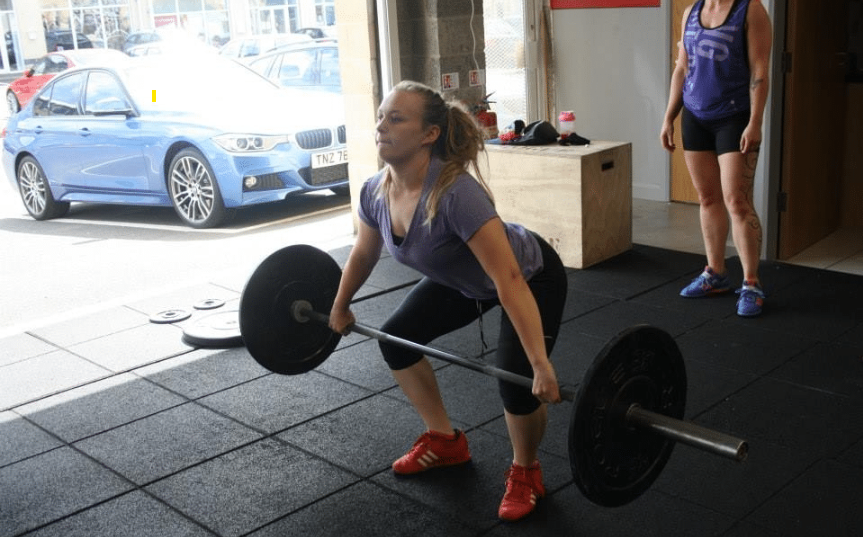
Exercise 2: the Clean:
Definition: one (1) uninterrupted, accelerated movement from the floor to the shoulders, catching with elbows parallel to the floor.
Variations:
The Hang Clean: A clean, but with the bar starting “hanging” in the arms, already elevated above the floor
The Power Clean: A clean, but catching the barbell in a position with the thighs at or above parallel with the floor.
These terms, in exactly the same way as the snatch, can be combined into a hang power clean, where the lifter starts with the bar already elevated off the floor, and catches the barbell in a high position (thighs above parallel).
The clean can also be broken down into the same phases as the snatch.
Grip:
 The clean grip, is the width where the hands are just by the sides, or slightly wider than shoulder width.
- There’s no maximum width, but the wider the grip, the more shoulder mobility that’s needed to catch the bar on the shoulders.
- If the catch / front rack position is impossible, it’s usually tightness in the rotator cuff and or lats.
- Place the bar in a squat stand at shoulder level, if you can elevate the elbows to parallel with a neutral grip (thumbs under bar, palms facing each other) then rotator cuff is your big issue
- If the elbows cant come up with the neutral grip, it’s time to stretch lats.

Phases of the Clean:
For your assessment, the key phases you’ll need to know are: the first pull, transition, second pull and catch.
As you read through, you’ll see significant overlap in the positions, so if you’re comfortable, the key differences are in bold and mostly in the catch, otherwise it’s a good revision/refresh.
Start Position:
 The start position is where the bar is about to separate from the floor, it is the first position on the lift.
- Set up by bringing the edge of the laces under the barbell, level with the knuckles of the toes.
- There should be a small gap between the shins and the barbell, this will allow the bar to move slightly towards the lifter during first pull. The bar should move either straight up, or slightly back, but not forward at this point.
- Knees should be gently squeezed up against the inside of the elbows, and not behind
- Feet should be hip width apart (not between feet and shoulder, as your shoulders have bugger all to do with your feet, and some ladies hips are wider than shoulders, so you’ll do more harm than good)
- Arms straight and loose
- Head looking straight, forward, and level. (the fluid canals in your ears affect balance, so keep the head level throughout. rather than looking at the floor)
- Hook Grip!
- The weight distribution should be on the forefoot, on the balls of the feet (but not the toes)

First Pull:
 The first pull starts as the bar separates from the floor, and ends just below the knee
- The bar should move slightly towards the lifter during this movement, or straight up.
- The back is flat and the chest is spread, and the lifter takes a deep breath before they lift. (valsalva / epiglottal bracing), causing high pressure and a solid base by squeezing the diaphragm.
- The centre point of the chest (where the ribs meet at the base of the sternum) should be directly over the barbell, this is what we mean by chest over the bar.
- A good cue to begin to move the bar is lead with the chest, or push the floor away, as the chest position elevating will lift the bar.
- The hips and shoulders should move at the same rate, keeping the back angle constant to the floor during the entire first pull. (parallel white lines shown)
- The cue “knees back” is often used, but this can be good or bad cue, depending on the movement.
- Knees of lifters with shorter femurs won’t move back noticeably at all, and longer femurs will be more noticeable due to the mechanics involved.
- If the bum lifts and back angle changes, forget knees back as it’ll make it worse
- If the lifter is coming on to the toes, use the cue, although i’ve had better success with “let the hips drift back slightly”, to get the bar to move subtly towards the lifter without causing a massive swing of the bar at Vmax.
- The weight distribution move gradually back towards the ankles throughout the first pull. You may hear weight on the heels as a cue, like knees back, it’s good or bad depending on the understanding. The heel (calcaneus) is directly below and behind the ankle, and some lifters think its somewhere behind the back of their shoe. A good way to know you’re in the sweet spot is if you can wiggle your toes, but not tap your feet while holding the barbell stationary.

Transition:
 The transition occurs as the bar passes the knees.
- The knee angle should remain fixed as much as possible during this time (barbell moving from below the knee to above the knee)
- Any large knee extension will put the load onto the back, which isn’t ideal, as it will then take over the lift, losing the effectiveness for sport of the triple extension
- Any large knee flexion will stall the barbell, slowing it down, and making it harder to accelerate the barbell.
- Some schools of thought taught the scoop or regrouping phase of the lift, in short, they’re disappearing as more research comes out. If you base movements on collegiate basketball player studies, of course they’re going to have noticeable knee flexion and extension, their legs are longer than most entire humans, and they’re not going to be the best technical lifters on which to base your movement skills.
- Elite level lifters in studies, and investigation of movement mechanics show that a minimisation of movement (knee flexion and extension) at this point of the lift is optimal, even if it does occur.
- This is also the point where the weight distribution should become semi-fixed, pushing through the ankles until the very last second.

Second Pull:
 The second pull starts is where the bar finishes transitioning past the knee, and continues through triple extension (Vmax).
- The bar should be in contact with, but only skimming the thighs, too far away, and it’s a back lift, resting on the thighs with knees too far under, and it’s a stall. brush or skim the thighs on the way past. Treat the bar like your favourite and sharpest razor, and aim for a close and smooth shave, rather than a hairy or bloody mess.
- If the bar wants to fall forward and away from the thighs, the knees are extended and too open, causing the back to do much of the lift, this isn’t a deadlift in the conventional powerlifting sense, we need to keep accelerating the bar upwards. The weight is also likely too far onto the balls of the feet.
- “Load the hamstrings” – boy do i hate this one at times, somewhere the consensus on the difference between a loaded muscle and a stretched one went out the window. If you ask any athlete to show you a loaded bicep, they’ll do the standard emoji bicep flex, and they’re right. So if we look at the knees, they are the equivalent to the elbow joint in the legs, so a loaded hamstring is a bent knee. More often than not, you ask someone to load their hamstrings, they’ll do a good morning or RDL where they feel their hamstring stretch…. the exact opposite of what we want to occur at this point. The knees should remain flexed, stretching the quads and glutes (muscles around a joint in flexion) which then pull harder as they’re preloaded and stretched (SSM from way back in theory). When glutes and knees extend, (along with ankles), we get a vertical jumping movement, the most effective way of getting a barbell into the air.
- Anyway… the continually extending knee, and hip continue to accelerate the bar vertically, reaching maximum acceleration as the bar reaches a height slightly lower than the hip (the grip is narrower than the snatch).
- At the very last instant, the pull is accelerated further by plantarflexion of the foot, and shrugging of the shoulders, completing the second pull and reaching Vmax.
- The arms are still straight, and we’re looking for maximum vertical displacement, and minimal horizontal displacement of the bar.

Catch:
 Final movements of the clean occur to secure the bar on the shoulders, and the movement is instantaneous with the end of the second pull. A key reason it’s so important to shrug, is that this gives the timing to pull under the bar. unless we suddenly grow 10cm during a lift, once we’ve reached maximum extension, owing to our acceleration and upwards momentum, the feet are going to leave the ground.
- As soon as the feet separate from the floor, the lifter aggressively pulls under the bar to secure it on the shoulders, skimming their body close, fast and low in relation to the bar. Heavier bars won’t go as high, so a full squat position is needed for the heaviest of lifts.
- The feet move out from the pulling (hip width) position, to just outside of hip width, to accommodate the hips in the squat. The distance should be about half the width of the foot on either side.
- Feet will land turned out, about 10 and 2 of a clock face, or 16 degrees.
- It’s not a flop or a drop, but an active pull under the bar to catch it securely on the shoulders. (dropping happens to you, pulling under is something you actively do.)
- Once the bar is secured, the lifter stands back up, and either drops the bar to go again if just performing cleans, or begins the next lift (the Jerk) if performing both together consecutively.

Overview:
You can click the image below to get a large printable copy to keep with you, or ask us during your practical and we’ll get large posters made up for the class to take away.

Comments are closed, but trackbacks and pingbacks are open.