
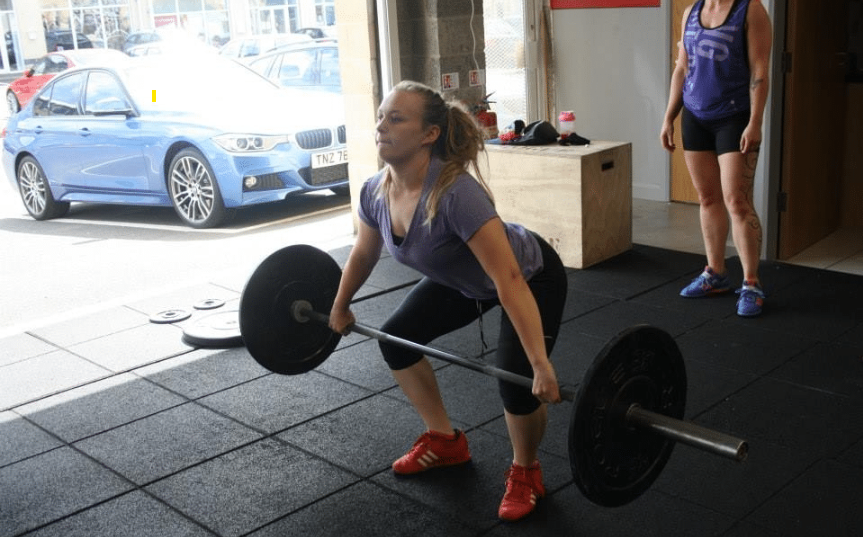
Exercise 3: the Jerk:
Definition: one (1) accelerated dip and drive, from the shoulders, catching the bar overhead with arms locked.
Variations:
The Split Jerk: A Jerk, where the feet “split”, one forward and one back during the catch
The Power Jerk: A Jerk, but catching the barbell in a position with the thighs at or above parallel, both aligned in the frontal plane
The Squat Jerk: As with the power jerk, but caught in a fully squatted position.
The Jerk’s key components can also be broken down into different phases. The different phases below offer some simple ways to explain the key markers where there are subtle changes in technique to most effectively lift the barbell.
There’s a chart at the bottom of this page that you can use as a guideline and print it for your own reference or for the wall in your gym.
Just before we get into the phases, it’s important to know how to grip the barbell: it’s the same as the clean, cool let’s move on.
Phases of the Jerk:
The key phases are: the dip, the drive, the catch (push under and split position), and the recovery.
Start Position:
- The start position is the final position in the clean, standing upright, with elbows parallel to the floor.
- The weight of the barbell should be spread along the anterior deltoids and clavicles.
- The back must remain upright (vertical) through the next phases.
- Feet should be hip width apart
- Head looking straight, forward, and level. (the fluid canals in your ears affect balance, so keep the head level throughout. rather than looking at the ceiling or floor)
- The weight distribution should be on the rear of the foot, very much on the posterior of the heel.
Dip:
- The descent part of the jerk is known as the dip
- Dip must be straight, (back stays vertical)
- The bar remains on the clavicles and deltiods during the dip
- The drive comes from the heels.
- A good cue to keep the back vertical, is “lean the hips back before you lift”, until you feel like they’re going to fall backwards.
- Another useful cue is to “only bend your knees” (this isn’t actually possible, but gets the shift of concentration away from hip flexion and tipping forward)
- The dip is short and sharp, with the bar in contact with the shoulders throughout.
Drive:
- The drive is powerful (explosive) and vertical.
- The legs and shoulders both drive the bar vertically, (triple extension and shrug to Vmax)
- The elbows may drop a little, but the bar is still driven by the legs and shoulders, this is not a press!!!.
Catch:
- As soon as the feet leave the floor, the lifter pushes themselves under the bar, using explosive shoulder drive (arms up to the ceiling)
- The bar is caught at arms length. Again we are not trying to press the bar into the air. Shoulder press and push press are arm dominant exercises, the drive and skill from the jerk is that the work comes from the legs.
- Split Jerk:
- The knee of the front foot lands behind the ankle, keeping a minimum of 90 degrees of the shin to the floor.
- The back knee must be bent to ensure an upright torso, as well as prevent lordosis
- The bar is caught posterior to the head, some may struggle with the necessary flexibility (lats)
- The feet remain equidistant from the saggital plane (it’s not an in line lunge, keep the feet hip width apart.) think railroad tracks, not a tightrope.
- Rear foot lands first,
- front foot should land with the heel making first contact before going flat
- Power and Squat Jerks:
- Feet land simultaneously
- Feet remain aligned along the frontal plane
- The overhead position is the same as the split Jerk.
Recovery:
- Split Jerk:
- Recover from the “Front-Foot-First”
- Push upwards from the front leg, rather than back, keeping the barbell balanced overhead.
- Once the upward push of the front foot takes the weight temporarily from the foot, slide the front foot towards the body, or step towards the frontal plane, either works, but sliding the foot gives a point of contact at all times.
- Step the back foot into line with the frontal plane, bringing both feet into the same line, with the bar secured overhead.
Overview:
You can click the image below to get a large printable copy to keep with you

Comments are closed, but trackbacks and pingbacks are open.